
Canada Swords: The Rising Legacy of Japanese Katana in the Great White North
Share
The morning mist clung to the mountains of British Columbia as Master Tanaka drew his katana, the steel singing a song older than Canada itself. For centuries, the relationship between Japanese sword craft and the Western world has been one of fascination, respect, and growing appreciation. Today in 2025, across the vast landscapes of Canada, from the bustling streets of Toronto to the quiet studios of Vancouver, a new generation of sword enthusiasts, collectors, and martial artists are discovering the profound artistry and spiritual depth of authentic Japanese blades.
Table of Contents
- The Historical Journey: How Japanese Swords Crossed the Pacific
- The Soul of Steel: Understanding Katana Philosophy
- Masterful Craftsmanship: The Art of Japanese Blade Making
- Our Collection: Premium Katana for Canadian Enthusiasts
- The Collector's Path: Building Your Sword Legacy
- Steel Types & Quality: Understanding the Blade
- Why Choose Katana Canada
The Historical Journey: How Japanese Swords Crossed the Pacific
The story of Japanese blades in Canada begins not with conquest or colonization, but with mutual respect and cultural exchange. Following the Meiji Restoration of 1868, Japan began opening its doors to the world, and with it came the gradual introduction of katana and other traditional weapons to Western collectors and scholars. The Ultimate Guide to Katana Langley: The Art Japanese Swords: The Soul Buy Swords Online Canada:
The earliest documented Japanese katana in Canadian collections date back to the late 1800s, brought by diplomats, traders, and adventurous collectors who recognized the exceptional artistry of these blades. Unlike European swords, which were primarily viewed as battlefield tools, the katana represented something far more profound: a fusion of spiritual practice, artistic expression, and functional excellence.
During the post-World War II era, Canadian sword collecting experienced a significant surge in Japanese cultural appreciation. Veterans returning from the Pacific theater often spoke of the incredible craftsmanship they had witnessed, sparking growing interest in Japanese martial arts and weaponry. The establishment of judo and later karate dojos across Canadian cities created communities where the philosophy behind the katana could be properly understood and respected.
The 1970s and 1980s marked a turning point as popular culture, particularly through films and literature, brought samurai traditions into mainstream Canadian consciousness. This wasn't mere fascination with exotic weaponry: Canadians began appreciating the deeper cultural significance of the katana as a symbol of honor, discipline, and artistic achievement.
Today in 2025, Canada hosts numerous Japanese sword collectors, martial artists practicing kendo and iaido, and artisans who study traditional Japanese metalworking techniques. Cities like Vancouver and Toronto, with their significant Japanese-Canadian populations, have become centers for authentic sword appreciation and education. The respect for Japanese craftsmanship aligns perfectly with Canadian values of multiculturalism and appreciation for fine artistry.
The Soul of Steel: Understanding Katana Philosophy
The katana transcends its physical form as a cutting tool. It embodies centuries of Japanese philosophy, spiritual practice, and cultural identity. To truly appreciate a katana, one must understand that it represents the harmonious balance between beauty and function, a concept that resonates deeply with many Canadian collectors and martial artists in 2025.
In Japanese culture, the katana is considered to possess a soul, or tamashii. This belief stems from the intensive spiritual and physical process required to create such a blade. Master swordsmiths would purify themselves through ritual and meditation before beginning work, understanding that their mental and spiritual state would be transferred into the steel itself. Each fold of the metal, each strike of the hammer, was performed with mindful intention.
The curved design of the katana, known as sori, is not merely aesthetic but represents the perfect fusion of cutting efficiency and structural strength. This curve allows for devastating cutting power while maintaining the blade's integrity during use. The single-edged design creates a natural cutting motion that flows like water, embodying the Japanese principle of achieving maximum effect with minimum effort.
Canadian practitioners of martial arts such as kendo and iaido understand that the katana serves as a tool for self-discovery and personal development. The practice of drawing, cutting, and sheathing the sword (noto) requires years of dedicated training to master. This discipline appeals to many Canadians who value patience, persistence, and the pursuit of excellence: qualities that align well with the Canadian character.
The aesthetic elements of the katana, the graceful curve, the pristine polish of the blade, the intricate work on the tsuba (hand guard), reflect the Japanese concept of finding beauty in simplicity and function. This philosophy has found a welcoming audience in Canada, where appreciation for craftsmanship and attention to detail is highly valued.
Modern collectors and enthusiasts across Canada often speak of the meditative quality of caring for and studying their katana. The regular maintenance required (cleaning, oiling, and proper storage) becomes a form of moving meditation that connects the owner to centuries of tradition and respect for the blade.
Masterful Craftsmanship: The Art of Japanese Blade Making
The creation of an authentic katana represents one of humanity's greatest achievements in metallurgy and craftsmanship. Understanding the intricate process behind these blades helps Canadian enthusiasts appreciate the exceptional value and artistry they're acquiring when they choose authentic pieces.
Traditional katana construction begins with tamahagane steel, produced through a labor-intensive smelting process using iron-bearing sand and charcoal in a clay furnace called a tatara. This ancient technique, largely unchanged for over a thousand years, produces steel with varying carbon content that skilled smiths separate and categorize for different parts of the blade.
The most common construction method, called kobuse-kitae, involves creating a hard steel (hagane) edge supported by softer, more resilient steel (shingane) for the spine and core. This differential hardness is achieved through careful forge welding and precise control of carbon content throughout the blade. The result is a sword that can hold an incredibly sharp edge while remaining flexible enough to absorb impact without breaking.
The iconic curve of the katana emerges during the yaki-ire (differential hardening) process. The blade is coated with a special clay mixture, leaving the edge thinner than the spine, and heated to precise temperatures before being quenched in water or oil. This dramatic cooling creates different crystal structures in the steel: martensite at the edge for hardness, and pearlite in the spine for flexibility.
The hamon, or temper line, visible on a polished blade represents the boundary between these different steel structures. Master smiths are recognized by their distinctive hamon patterns: straight, undulating, or complex geometric designs that are both functional and beautiful. These patterns are not merely decorative; they indicate the skill level of the smith and the quality of the heat treatment.
Modern reproductions available to Canadian collectors utilize high-quality carbon steels like 1060 and 1095, which, while not traditional tamahagane, can produce exceptional functional blades when properly forged and heat treated. The best contemporary pieces maintain the essential characteristics of traditional construction while being accessible to collectors and practitioners who value authenticity and functionality.
Our Collection: Premium Katana for Canadian Enthusiasts - Updated for 2025
Our carefully curated selection represents the finest katana available to Canadian collectors, combining authentic design elements with modern metallurgy and exceptional craftsmanship. Each piece in our 2025 collection has been selected for its historical accuracy, functional quality, and aesthetic beauty.
Tanjiro Kamado Katana Sword V2
This exceptional reproduction captures the essence of the legendary demon slayer's blade with remarkable attention to detail. The V2 edition represents our enhanced design featuring improved fittings and finish quality for 2025.
• Premium 1060 carbon steel construction for superior edge retention and durability
• Authentic black and green color scheme reflecting the character's signature style
• Hand-forged tsuba with intricate demon slayer corps motif
• Full tang construction ensuring structural integrity during practice
• Includes premium wooden scabbard with traditional lacquer finish
⭐⭐⭐⭐⭐ "Absolutely stunning piece! The attention to detail is incredible, and the balance is perfect for iaido practice. Shipping to Calgary was smooth and the customer service was exceptional." - Michael T., Calgary, AB
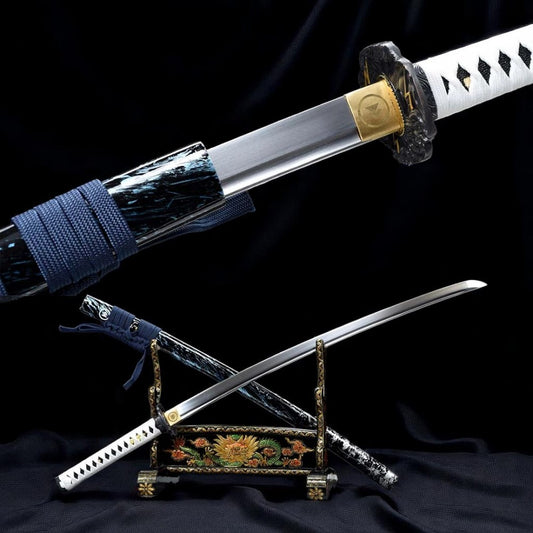
Jin Sakai Katana – Ghost of Tsushima Edition
Inspired by the legendary samurai from the critically acclaimed video game, this katana embodies the honor and artistry of feudal Japan's warrior class. The Ghost of Tsushima edition features unique design elements that set it apart from traditional reproductions.
• Museum-quality 1060 carbon steel blade with authentic differential hardening
• Distinctive tsuba design featuring traditional Japanese wave patterns
• Authentic ray skin (same) handle wrapping for superior grip
• Hand-forged blade with visible hamon line
• Comes with certificate of authenticity and care instructions
 Save $90