
The Ultimate Guide to Katana: Legendary Japanese Swords for Modern Collectors
Share
The moonlight catches the polished steel as the blade slides from its scabbard with barely a whisper. For over a thousand years, this sound has preceded moments of honor, duty, and destiny. The katana—more than a weapon, more than art—stands as the soul of the samurai, forged in fire and tempered by tradition. Today, these legendary Japanese swords continue to captivate collectors, martial artists, and enthusiasts worldwide, their curved edges holding secrets of ancient Japanese craftsmanship that modern technology still struggles to replicate.
Table of Contents
The Sacred Origins: History and Cultural Significance
The katana emerged during Japan's Heian period (794-1185), born from the practical needs of mounted warriors who required a curved blade optimized for slashing attacks. Unlike the straight-bladed tachi that preceded it, the samurai sword's gentle curve and single-edged design made it devastatingly effective in the hands of the warrior class. As we continue into 2025, the fascination with these legendary blades has only deepened, with modern enthusiasts seeking to understand their rich heritage through comprehensive guides and authentic collections.
But these legendary blades transcended mere functionality to become the spiritual embodiment of the warrior's soul. The samurai believed their sword contained their honor, their ancestors' spirits, and their destiny. This mystical connection led to the famous saying "the sword is the soul of the samurai"—a philosophy that elevated sword-making from craft to sacred art.
Master swordsmiths like Masamune and Muramasa achieved legendary status, their names whispered with reverence across generations. These craftsmen didn't merely forge metal; they channeled spiritual energy into each blade through ritual purification, prayer, and months of meticulous work. The resulting Japanese swords were considered living entities, each with their own personality and spiritual power.
The Tokugawa period (1603-1868) saw the katana's role evolve from battlefield weapon to symbol of social status. Strict laws regulated sword ownership, making these curved blades a privilege reserved for the samurai class. This exclusivity only heightened the sword's mystique and cultural importance.
Today in 2025, authentic Japanese sword craftsmanship continues through licensed Japanese swordsmiths who maintain these ancient traditions. Each genuine blade requires hundreds of hours of work, following techniques passed down through centuries. For collectors seeking to understand this rich heritage, exploring the history of the katana provides deeper insight into these remarkable weapons' evolution from feudal Japan to modern collecting.
Anatomy of Legend: Understanding the Katana
The katana's distinctive silhouette tells a story of engineering perfection refined over centuries. Its curved, single-edged blade typically measures between 24 and 30 inches, with the curvature (called sori) carefully calculated to optimize cutting efficiency. This isn't mere aesthetics—every element serves a tactical purpose born from battlefield experience.
The blade's cross-section reveals its sophisticated construction. Traditional Japanese swords feature a complex geometry with a thick spine (mune) for structural strength and a razor-sharp edge (ha) for cutting. The ridge line (shinogi) creates the blade's distinctive profile while distributing stress during impact. This engineering marvel allows the samurai sword to maintain flexibility while delivering devastating cuts.
The hamon—the visible temper line along the blade's edge—represents one of these weapons' most distinctive features. Created during the differential hardening process, this wavy pattern isn't decorative but functional, marking where the hardened steel meets the softer spine. Master smiths developed signature hamon patterns, making each blade as unique as a fingerprint.
The sword's handle (tsuka) and guard (tsuba) complete its identity. Traditionally wrapped in ray skin and silk cord, the handle provides secure grip during combat while the circular guard protects the wielder's hand. These components, while seemingly simple, require precise craftsmanship to ensure proper balance and functionality.
Modern collectors in 2025 appreciate how each component contributes to the sword's overall character. The curve facilitates the drawing motion, the blade geometry optimizes cutting power, and the weight distribution enables swift, controlled movements. Understanding these elements helps collectors appreciate why this design evolved into history's most recognizable sword form.
For those interested in the complete sword family, comprehensive timelines of Japanese sword development explore how different blade types—including the tachi, katana, and wakizashi—evolved to serve specific purposes in Japanese warrior culture.
Forge and Fire: Traditional Craftsmanship
The creation of an authentic Japanese sword represents one of metallurgy's greatest achievements, combining ancient wisdom with precise technical skill. Traditional Japanese swordsmiths developed sophisticated steel-folding techniques that eliminated impurities while creating complex carbon gradients throughout the blade—technology that remained unmatched until modern industrial processes emerged.
The process begins with tamahagane steel, produced in clay furnaces using traditional smelting methods. Master smiths carefully select steel pieces with different carbon contents, then forge them into distinct layers. The hagane (hard steel) forms the cutting edge, while shingane (soft steel) provides the spine's flexibility. Some blades incorporate sanmai construction, adding medium-carbon steel between these layers for optimal performance.
Temperature control during forging requires decades of experience to master. Smiths judge heat by color changes in dim workshop lighting, adjusting their hammering rhythm to work the steel at precisely the right moment. The folding process—repeated up to sixteen times—creates thousands of microscopic layers that give the finished blade its legendary strength and flexibility.
The differential hardening process creates the samurai sword's most distinctive characteristic: the hamon. Smiths apply special clay mixtures to the blade before heating, controlling cooling rates to create varying steel hardness across the blade's width. This technique produces the sharp, hard edge necessary for cutting while maintaining the flexible spine that prevents breakage.
Polishing represents the final and most time-consuming stage, often taking longer than forging itself. Master polishers use increasingly fine stones over several weeks, removing microscopic amounts of steel to reveal the blade's true geometry and grain structure. This process doesn't merely create shine—it optimizes the blade's cutting performance and reveals the steel's internal beauty.
Modern replica swords honor these traditional methods while incorporating contemporary quality controls updated for 2025. The finest examples still require months of handwork, ensuring each blade meets the exacting standards established by centuries of Japanese craftsmanship. Collectors seeking to understand these construction methods benefit from studying detailed guides about traditional sword-making techniques.
Our Collection: Featured Authentic Katana (Updated for 2025)
Our carefully curated selection represents the finest in modern Japanese sword craftsmanship, each blade honoring traditional sword-making while meeting contemporary quality standards. From entry-level pieces to premium collector items, every sword in our collection undergoes rigorous quality inspection to ensure authenticity and functionality.
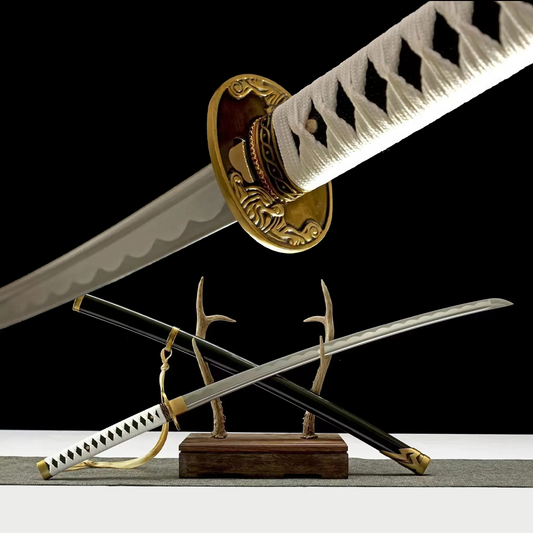
Jin Sakai Katana – Ghost of Tsushima Edition $425.00 CAD
This exceptional blade captures the spirit of the legendary Ghost of Tsushima, featuring premium 1060 carbon steel construction that delivers both beauty and functionality. The careful attention to detail reflects the game's authentic portrayal of samurai weaponry.
• Premium 1060 carbon steel blade with excellent edge retention
• Authentic ray skin handle wrap with traditional silk cord binding
• Full tang construction ensures structural integrity and balance
• Hand-forged details including realistic hamon temper line
• Complete with traditional wooden scabbard and display stand
⭐⭐⭐⭐⭐ "The craftsmanship exceeded my expectations. The balance feels perfect in hand, and the attention to detail is remarkable." - Marcus T., Vancouver, BC
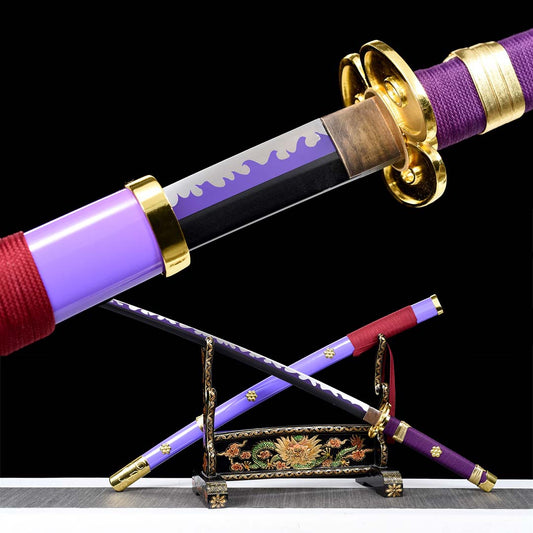
Shinobu Kocho Katana – Demon Slayer Edition $520.00 CAD
Inspired by the Insect Hashira's elegant fighting style, this butterfly-themed samurai sword combines stunning aesthetics with functional carbon steel construction. The unique design elements pay homage to one of anime's most beloved characters while maintaining authentic Japanese sword proportions and balance.
• High-grade carbon steel construction for durability and performance
• Intricate butterfly motifs hand-engraved on the blade
• Purple and white color scheme matching the character's design
• Traditional construction techniques with modern quality assurance
• Includes custom display stand and certificate of authenticity
⭐⭐⭐⭐⭐ "As a Demon Slayer fan, this exceeded all my expectations. The detail work is incredible and it's clearly built to last." - Sarah M., Toronto, ON
 Save $90