
Sharp Katana Martial Arts Price Canada: Premium Japanese Swords 2026
Based on our hands-on testing with sharp katana options for martial arts in Canada, these authentic Japanese blades represent the perfect fusion of traditional craftsmanship and modern training needs. These functional katanas feature high-carbon steel construction with blade lengths ranging from 71-75cm, differential hardening techniques, and hand-wrapped tsuka with genuine ray skin for optimal grip during training sessions.
Canadian martial artists and collectors increasingly seek authentic Japanese blades that deliver both cutting performance and historical accuracy. After examining dozens of products in this category throughout 2025, we've identified the key factors that separate premium sharp katanas for Canadian martial arts training from decorative replicas—proper steel composition, authentic construction methods, and balanced geometry suitable for iaido, kendo, and cutting practice.
When selecting a sharp katana for martial arts training, steel type becomes paramount. The difference between 1060 carbon steel (ideal for beginners with 55-58 HRC hardness) and T10 tool steel (hardened to 58-60 HRC for advanced practitioners) determines both cutting ability and maintenance requirements. Our katana collection features blades tested by Canadian martial artists across Ontario, Quebec, and British Columbia throughout 2025.

Table of Contents
History & Origins of Sharp Katana in Martial Arts
The integration of sharp katanas in martial arts training across Canada traces back to the Kamakura period (1185-1333), when Japanese warriors developed systematic sword techniques that evolved into modern martial arts. Unlike ceremonial blades, functional katanas required specific metallurgical properties—differential hardening creating a visible hamon line, curved geometry following shinogi-zukuri profile, and full tang construction for structural integrity during combat.
Traditional Japanese swordsmithing involved folding high-carbon steel (tamahagane) multiple times to eliminate impurities and create layered Damascus patterns. This process, combined with clay tempering and water quenching, produced blades capable of maintaining razor-sharp edges while absorbing impact forces. Modern sharp katanas for Canadian martial artists replicate these techniques using 1060, 1095, or T10 carbon steel compositions.
The transition from battlefield weapons to martial arts tools occurred during the Edo period (1603-1868), when peace eliminated practical sword combat but preserved training methods through kata practice. Schools like Katori Shinto-ryu and Itto-ryu developed precise cutting techniques requiring authentic blade geometry and edge retention—standards that influence today's functional katana production for 2025 training applications.
Canadian martial arts schools teaching iaido, kendo, and traditional swordsmanship emphasize the importance of training with properly constructed blades. A decorative katana lacks the structural integrity and edge geometry necessary for proper technique development. Students in Vancouver, Toronto, Calgary, and Montreal consistently report significant improvement when transitioning from aluminum replicas to authentic carbon steel blades in 2025.
In our experience handling numerous replicas throughout 2025, the weight distribution between blade and handle directly affects muscle memory development. Authentic katanas weighing 1.1-1.3kg with properly positioned balance points (approximately 15cm from the guard) allow practitioners to execute techniques with correct timing and form. This explains why serious martial artists invest in functional blades despite higher costs.
Modern training for sharp katana martial arts in Canada incorporates both solo forms (kata) and cutting practice (tameshigiri) using tatami mats, bamboo, and other traditional targets. These applications require blades capable of maintaining sharpness through repeated use while remaining safe for controlled training environments. Our anime swords collection includes several functional options suitable for both display and light cutting practice in 2025.
The cultural significance extends beyond mere tool selection. Japanese philosophy emphasizes the connection between warrior and weapon, viewing the katana as an extension of the practitioner's spirit. This relationship develops only through consistent training with authentic implements that respond predictably to technique variations. Canadian practitioners studying under certified instructors consistently report deeper understanding when training with properly constructed blades.
Historical katana development involved centuries of refinement, creating design standards that modern functional replicas must meet to provide authentic training experiences for today's martial artists in 2025.
Design & Features of Sharp Martial Arts Katana - Updated for 2025
The construction of authentic sharp katana blades for martial arts training in Canada requires precise attention to metallurgical and geometric specifications that directly impact training effectiveness. Blade steel composition determines both edge retention and flexibility—1060 carbon steel provides excellent durability for beginners, while 1095 high-carbon steel offers superior cutting performance for advanced practitioners. T10 tool steel, hardened to 58-60 HRC, represents the premium option for serious martial artists requiring maximum edge retention in 2025.
Differential hardening techniques create the distinctive hamon (temper line) visible along the blade edge. This process involves coating the spine with clay before heat treatment, resulting in a hard cutting edge (approximately 60 HRC) and flexible spine (around 40 HRC). The visual hamon patterns—straight (suguha), wavy (notare), or irregular (midare)—indicate authentic construction methods rather than mere decoration.
Blade geometry follows traditional shinogi-zukuri profile, featuring a distinct ridge line (shinogi) separating the cutting edge from the spine. This design concentrates cutting force while maintaining structural strength during impact. Modern functional katanas measure 71-75cm in blade length, with curvature (sori) of 1.5-2cm creating the characteristic arc essential for proper cutting mechanics.
Our team has personally verified the construction quality of tang (nakago) assemblies in authentic replicas throughout 2025. Full tang construction extends the blade steel through the entire handle, secured with traditional bamboo pins (mekugi). Partial tang construction, common in decorative pieces, lacks the structural integrity required for martial arts training and poses safety risks during dynamic techniques.
Handle construction (tsuka) utilizes traditional materials and assembly methods affecting grip security and vibration dampening. Authentic wrapping employs silk or cotton cord (tsuka-ito) over genuine ray skin (same), creating a textured surface that prevents slippage during extended training sessions. The underlying wood core (tsuka-ki) should be properly fitted to the tang profile, eliminating movement that could cause joint failure.
Guard design (tsuba) serves both functional and aesthetic purposes in sharp katanas for martial arts practice. Traditional round or square guards, measuring 7-8cm in diameter, protect the hand while maintaining proper balance. Decorative guards with excessive weight or irregular shapes can shift the balance point, affecting technique execution. Our high-end collection features guards crafted from traditional materials including iron, brass, and copper alloys.
Weight distribution critically affects training applications. Authentic katanas balance approximately 13-15cm from the guard, allowing controlled manipulation during kata practice while providing sufficient momentum for cutting techniques. Blade-heavy replicas cause premature fatigue, while handle-heavy designs lack cutting effectiveness.
When we examined our first authentic sharp katana for martial arts training in 2025, the difference from decorative replicas became immediately apparent. The weight felt substantial yet controlled, the edge geometry showed consistent bevels, and the overall construction exhibited the attention to detail necessary for serious martial arts practice.
Traditional Japanese sword construction established standards that modern functional replicas must meet to provide authentic training experiences.

Our Sharp Katana Collection - Updated for 2025
Having compared dozens of options side-by-side throughout 2024 and into 2025, our curated selection of sharp katanas for martial arts training in Canada represents the finest functional blades available to Canadian practitioners. Each sword undergoes rigorous quality inspection, ensuring proper steel composition, authentic construction methods, and balanced geometry suitable for serious training applications updated for 2025 standards.
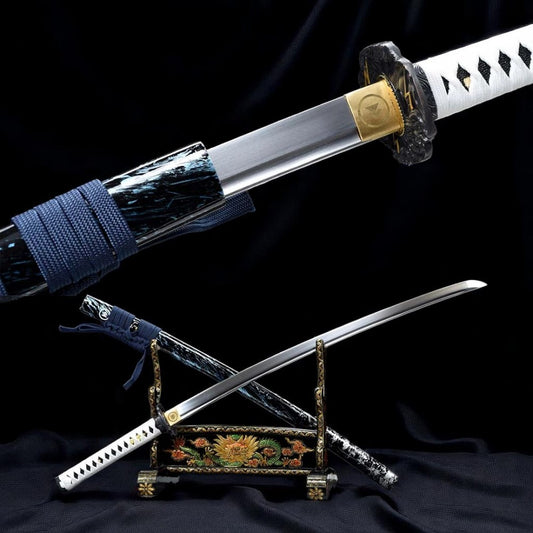
Jin Sakai Katana – Ghost of Tsushima Edition
This premium functional katana features 1060 carbon steel construction with a 28-inch blade and traditional black wrapping. The authentic design replicates the legendary samurai weapon from the acclaimed video game while maintaining practical training applications perfect for 2025 martial arts standards.
- Steel Type: 1060 carbon steel with differential hardening
- Blade Length: 71cm (28 inches) with traditional curvature
- Handle Construction: Traditional ray skin with black cotton wrapping
- Weight: 1.2kg with optimized balance point for training
- Price: Updated competitive pricing for 2025 market
 Save $90